Direct answer
Choose the coating from the project coating specification, operating temperature, external environment, handling and installation conditions. 3LPE, 3LPP and FBE are different systems and cannot be compared from a name alone. The RFQ should define the governing coating standard, system and thickness, cutback, field-joint coating, tests, repair method and documentation.
The pipe standard and coating standard are separate requirements. API 5L defines the line pipe product; the coating specification defines the external corrosion-protection system and its quality controls.
How the systems differ
| System | Typical construction | Procurement questions |
|---|---|---|
| 3LPE | Epoxy primer, adhesive and polyethylene outer layer. | Application standard, total and layer thickness, service temperature, impact resistance, cutback and repair procedure. |
| 3LPP | Epoxy primer, adhesive and polypropylene outer layer. | Whether the qualified system matches the service temperature and mechanical exposure, plus system-specific tests and end/field-joint details. |
| FBE | Fusion-bonded epoxy single-layer system. | Coating grade, DFT, surface preparation, holiday test, adhesion, impact and repair requirements. |
Do not select a system because it is described as “better” in general marketing. Select the system qualified for the project conditions and accepted by the purchaser.
Fields the RFQ must contain
- Line-pipe standard, grade and dimensions.
- Coating specification, revision and application standard.
- System and layer arrangement.
- Total DFT and individual-layer thickness requirements where applicable.
- Cutback length and pipe-end protection.
- Field-joint coating requirement.
- Surface preparation and application conditions.
- Holiday, adhesion, impact, flexibility and visual inspection.
- Repair criteria and repair procedure.
- Coating report, traceability and third-party witness points.
Make coating offers comparable
| Offer item | What should be stated |
|---|---|
| Coating system | Named system with the governing project or coating standard. |
| Thickness | DFT and layer requirements, not only “standard thickness”. |
| End preparation | Cutback, bare-end length, protection and field-joint supply. |
| Testing | DFT, holiday, adhesion, impact and any project-specific tests. |
| Third-party inspection | Whether coating witness points are included or quoted separately. |
| Repair | Allowable repair method and approval of repaired areas. |
| Documentation | Coating report, test results, traceability and final data-book requirements. |
Do not stop at a visual inspection
Require measurements and records that match the coating standard and project specification. Record where the inspection occurs, who witnesses it and how repaired areas are released. Store coating records with the heat or production traceability used for the pipe order.
What drives the selection
The buyer and coating applicator need more than a pipe dimension. Define the maximum and minimum operating temperature, installation method, soil or atmospheric exposure, expected mechanical damage, UV exposure during storage, field-joint process and design life. These inputs determine which qualified coating system and test programme are relevant.
At quotation stage, ask the seller to identify the coating applicator that will be used and whether the offered system is already qualified for the stated conditions. If the project allows no alternative, name the approved coating standard, revision and product family. If alternatives are permitted, require deviations to be stated rather than silently substituted.
Protect the coating after application
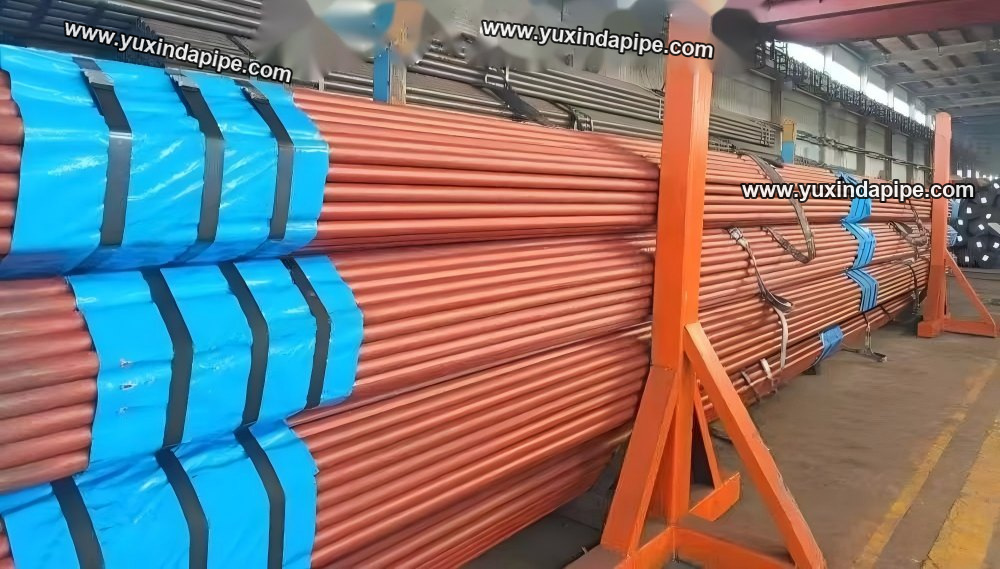
Coating quality can be lost through poor handling, sunlight exposure, dirty storage or damaged pipe ends. Agree the storage period, end caps or protectors, lifting method, dunnage, stack height and load restrictions. For field joints, identify who supplies the compatible coating material and who inspects the completed joint.
Start with the line pipe and then define the coating
Use the LSAW line pipe page or API 5L overview for the pipe basis. Then use the RFQ checklist to collect the coating data before asking for a quotation.